
The Wisdom of the Ancients
Daily Pundit: September 9, 2025

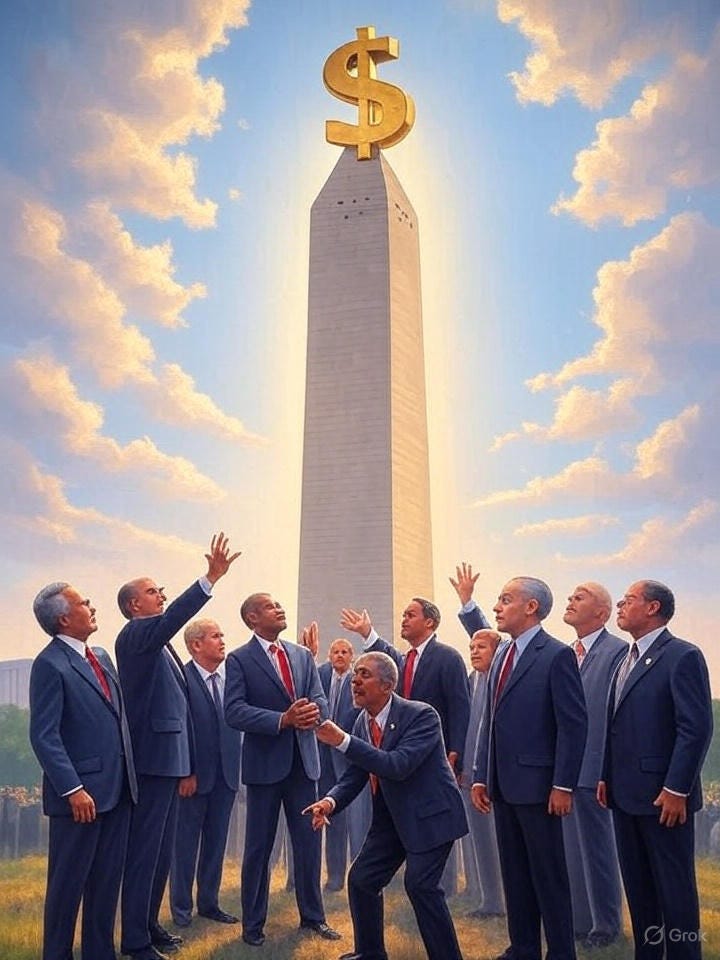
From Reluctant Service to Ruthless Ambition: Washington's Shadow in Today's Political Arena
In the annals of American history, few moments capture the essence of true leadership quite like George Washington's private letter from Mount Vernon, penned just 30 days before his inauguration as the nation's first president. "My movements to the chair of government," he wrote to his friend James Madison, "will be accompanied by feelings not unlike those of a culprit who is going to the place of his execution." These words reveal a man burdened by duty, not driven by desire. Washington, the victorious general who had just led the colonies to independence, viewed the presidency not as a prize but as a solemn obligation—one he accepted only after immense reluctance and the insistent pleas of his fellow Founders.
Contrast this with the spectacle of contemporary American politics, where the pursuit of power has devolved into a frenzied auction. Candidates pour tens of millions of dollars into campaigns for offices that offer salaries in the mere hundreds of thousands—peanuts compared to the fortunes they amass through influence, insider deals, and outright grift. This isn't public service; it's a predatory enterprise, where elected officials treat the public trust as a personal ATM. Men and women who swear oaths to represent the people instead line their pockets, betraying every principle Washington embodied. They are not leaders but opportunists, fake stewards of democracy who serve only their insatiable lusts for wealth and control.
Washington's path to the presidency was the antithesis of this avarice. After the Revolutionary War, he could have seized absolute power. In 1783, some officers even plotted a military coup, the Newburgh Conspiracy, tempting him with the trappings of monarchy. But Washington rejected it outright, dissolving the Continental Army and retiring to his Virginia farm. He turned down offers of a kingship, insisting that the new republic must be governed by laws, not men. It took the unanimous vote of the Electoral College in 1789—and the earnest importunings of figures like Alexander Hamilton and Madison—to drag him from Mount Vernon. Even then, he approached the role with dread, aware of its perils and his own limitations. His two terms were marked by restraint: he set precedents for voluntary term limits, warned against partisan factions in his Farewell Address, and stepped aside without fanfare. Washington left office poorer than when he entered, his estate burdened by debts. Here was a moral giant, a Cincinnatus of the age, who prized virtue over vanity.
Fast-forward to 2025, and the landscape is unrecognizable. Today's politicians exhibit an unbridled lust for power that would appall the Founders. Consider the financial calculus: a U.S. House seat pays about $174,000 annually, the Senate around $200,000. Yet challengers routinely spend $10 million or more to win them. Why? Not for the paycheck, but for the golden ticket to enrichment. Once in office, they leverage their positions for personal gain—through stock trades timed with legislative knowledge, campaign funds funneled to family businesses, or sweetheart deals with lobbyists. This grift turns public servants into millionaires overnight, or at least in the blink of a congressional term. It's a system rotten to the core, where the "representatives of the people" represent only their own greed.
Take Nancy Pelosi, the long-serving Democratic powerhouse from California. When she entered Congress in 1987, her net worth was modest. By 2025, estimates place it at over $250 million. Much of this fortune stems not from her salary but from savvy—and suspiciously timed—investments by her husband, Paul Pelosi, a venture capitalist. The Pelosi portfolio has included blockbuster trades in tech stocks like Nvidia and Apple, often coinciding with committee briefings on semiconductors and antitrust matters. Critics point to instances where House Democrats, including Pelosi's allies, received classified information that could sway markets. In 2022 alone, her family's trades netted millions while the CHIPS Act funneled billions to chipmakers. Pelosi has dismissed ethics complaints, but the optics are damning: a public servant presiding over policies that enrich her family. This isn't coincidence; it's the unconstrained greed that Washington abhorred, using the levers of government to pad pockets at taxpayer expense.
Then there's Ilhan Omar, the Minnesota congresswoman whose rapid ascent to wealth exemplifies the overnight millionaire phenomenon. Elected in 2018 amid progressive fervor, Omar has faced scrutiny for financial improprieties from the start—allegations of campaign fund misuse and improper reimbursements for travel. But the real eyebrow-raiser came in her 2025 financial disclosure, revealing a net worth ballooning to as much as $30 million. Just months earlier, she had publicly denied being a millionaire, claiming her finances were "humble." How does one go from student loans and a modest background to such riches on a congressional salary? Disclosures show investments in real estate and stocks, plus consulting fees tied to her political network. Omar has refuted the claims, attributing growth to "legitimate opportunities," but the timing raises red flags—especially amid her vocal criticism of "corporate greed" while her own assets multiply. It's a classic case of hypocrisy: preaching equity from the pulpit of power, all while feathering her nest. Washington, who lived frugally and refused undue compensation, would see this as the very corruption he fought to prevent.
And don't overlook Bernie Sanders, the self-proclaimed socialist firebrand from Vermont. Sanders has railed against the "1 percent" for decades, authoring bills to tax the ultra-wealthy and curb inequality. Yet his own trajectory tells a different story. Entering the Senate in 2007 after stints as mayor and House member, Sanders' net worth hovered around $500,000. By 2019, it had surged to $2.5 million or more, largely from lucrative book deals like Our Revolution and It's OK to Be Angry About Capitalism. These royalties, paid by major publishers, netted him over $1 million in a single year. Add in three homes—one a lakefront vacation property in Vermont—and generous government pensions, and you have a multimillionaire decrying millionaires. Sanders defends it as earned income from speaking his mind, but the irony is thick: he uses his platform, built on public office, to profit handsomely while voting against tax breaks for everyday workers. This isn't the reluctant service of Washington; it's the amoral exploitation of a bully pulpit for personal enrichment. Sanders, like his peers, embodies the power-crazed elite who lecture on morality while embodying its opposite.
These examples aren't anomalies; they're the norm in a Congress where nearly half the members are millionaires, far outpacing the general population. The lust for power manifests in endless reelection bids, gerrymandered districts, and dark money floods that drown out genuine voices. Politicians spend fortunes—often from wealthy donors expecting favors—to secure seats, then wield authority not for the common good but for self-aggrandizement. They gerrymander maps to entrench themselves, suppress voter access under the guise of security, and pass laws that benefit insiders. It's a far cry from Washington's era, when leaders like him, Jefferson, and Adams debated in pamphlets and town halls, accountable to ideas rather than PACs.
The moral decay is profound. Washington embodied civic virtue: duty over desire, republic over royalty. He warned in his Farewell Address of the dangers of ambition unchecked by principle. Today's crop of officials ignores such wisdom. They are immoral and amoral opportunists, fake representatives who feign concern for the people while pursuing unbridled lusts. Pelosi's trades, Omar's windfall, Sanders' royalties—these aren't isolated slips but symptoms of a diseased system. They enter office as servants and emerge as swells, their "service" a smokescreen for graft.
What would Washington think of this? He'd likely echo his own words, viewing modern D.C. as a place of execution—for the soul of the nation. The Founders dragged him to power under duress because they trusted his reluctance as proof of his integrity. Today, we endure volunteers who claw their way in, driven by ego and avarice. This inversion of values threatens the republic's foundation. If we are to reclaim it, we must demand leaders who approach power with Washington's humility, not the greed that devours it.
In the end, the contrast is stark: one man who feared the chair of government, and a legion who claw for it like vultures. Until we purge this corruption, America's experiment hangs by a thread, frayed by those who swore to mend it.
I don't know for sure that George Washington was the greatest man who ever lived. Cincinnatus is right up there, and a few others from history. But George Washington certainly has a place among the greatest men who ever lived.
As for today's Congress and their hangers-on, they're not the most corrupt, dishonest, and morally bankrupt collection of dullards who ever lived. They're not even representative of the American populace, in that they are more corrupt than the average American. My only concern about them is the gnawing worry that they may be the Congress that we deserve.
Washington was NOT "offered" the post. The letter proposed a scheme for a new western military colony with a mixed government headed by someone with the title of king but Washington was not mentioned in the letter.